Zeroing
Zeroing Distances Explained: 10, 25, 36, 50, and 100 Yards
A reference on which zero distance to pick, for pistols and rifles. What each one is for, where the bullet crosses, who it suits, and how each one fails.
Read the article
Age verification
Outlaw Valley Tactical sells optics and accessories intended for adults. You must confirm that you are 18 or older to enter this site.
By entering you agree to our Terms of Service and Privacy Policy.
NEW PRODUCTS ADDED!
How high your optic sits changes your head position, your neck, and where your rounds land up close. Pick the height first, then buy the mount.

Mount height is the setup decision people skip. They pick an optic, buy whatever mount came bundled with it, bolt it on, and then spend a year wondering why their neck hurts after a class or why their rifle never quite feels natural.
Height is not a detail. It sets where your head has to be, how fast you find the dot when the rifle comes up, and how far below your point of aim the rounds land at close range. Here is what the numbers mean and how to choose.
Cowitness describes where your backup iron sights appear when you look through the optic. It only exists as a concept if you have irons mounted behind and in front of the optic on the same rail.
If the optic sits at the same height as the irons, the front sight post lands in the middle of the optic window. That is absolute cowitness. If the optic sits higher, the irons drop toward the bottom of the window. That is lower third.
Note what cowitness is not. It is not an accuracy feature and it does not make the optic hold zero better. It is only a description of the relationship between two aiming systems, and it becomes irrelevant the moment you decide not to run irons at all.
Roughly 1.42 inches from the top of the receiver rail to the center of the optic on a standard flat top AR-15. The front sight post sits dead center in the window, right where you would put the dot.
Absolute is the traditional choice and it is still correct for a lightweight, compact carbine where the irons are genuinely the backup plan and you want the smallest package possible.
Roughly 1.57 inches. The optic sits about a sixth of an inch higher, and that is enough to push the iron sights down into the bottom third of the window.
That small change buys you a clean upper two thirds of glass. The irons are still there, still usable if the optic dies, and no longer in the way of anything you are actually looking at. For a rifle that runs a red dot as the primary and irons as insurance, this is the sweet spot and it is the most popular height for good reason.
Head position is slightly more upright than absolute. Not dramatically, but enough to notice on a long string.
Both of these put the optic well above any iron sights, so cowitness stops being part of the conversation. You are buying head position, not a sight relationship.
1.93 inches. This is the height that has taken over modern carbine builds, and the reason is posture. At 1.93 you can hold your head level and look forward rather than tucking your chin down onto the stock. That is a more natural, more athletic position, it lets you keep both eyes genuinely open and scanning, and it reduces the neck strain that shows up in hour four of a class rather than minute four.
2.26 inches. Taller again. Built primarily for people running night vision, where the optic needs to sit high enough to see through a tube mounted in front of the eye. It also suits shooters in heavy body armor or a plate carrier with a high cut, where the chest and shoulder geometry pushes the whole rifle down and away.
Both of these push weight higher above the rail, which raises the felt center of gravity a little. In practice that matters far less than most internet arguments suggest.
Mounts
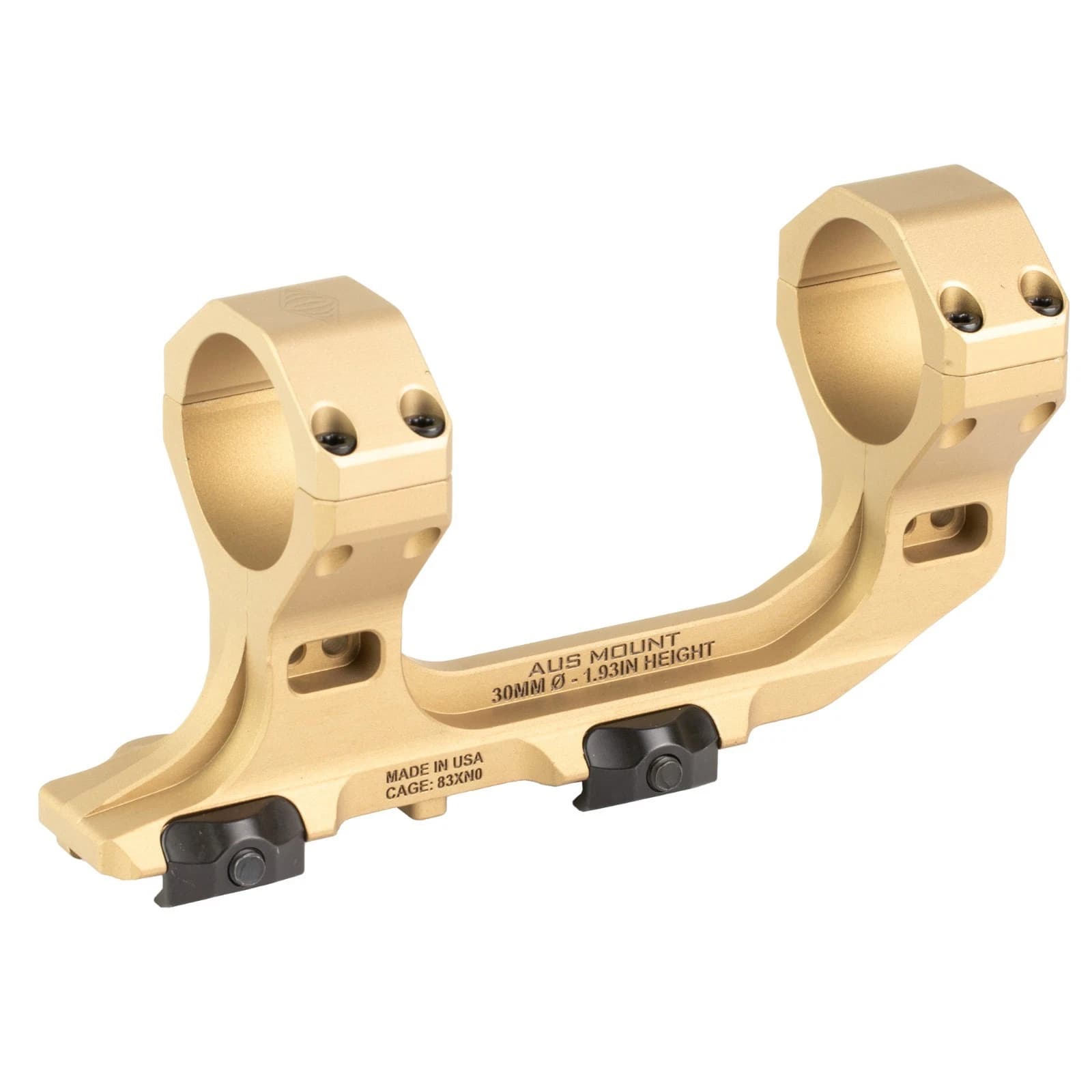
Reptilia AUS Mount 34mm, Flat Dark Earth, 1.93″ Bore Height – 100-243
$297.49
The optic sits above the bore. That gap does not disappear, and the higher you mount, the bigger it gets.
This is where the numbers above stop being the numbers you need, and it catches almost everybody. Every figure on this page so far has been measured from the top of the receiver rail, because that is how mounts are specified and sold. Your bore is not at the rail. On a standard flat top AR-15 the bore centerline sits roughly 1.2 inches below the top of the rail, so you add that to the mount height to get the number that actually governs your rounds.
Which makes the real height over bore:
At contact distance, before the bullet has had any chance to climb into your line of sight, the round lands roughly that full height below your aiming point. On an absolute cowitness setup that is about two and a half inches low. On a 2.26 mount it is closer to three and a half.
Worth naming the confusion directly, because manufacturers do not help: plenty of mounts are sold as a “1.93 bore height” or similar when the figure printed on the box is measured from the rail. If a spec sheet quotes a height in that range, it is a rail height, and the true distance above your bore is that number plus about 1.2 inches.
The better part of an inch between the lowest and highest mount sounds like nothing. It is not nothing when the target is small and close: a headbox at seven yards, a small steel plate at ten, a hostage target in a match. The fix is not a different mount, it is knowing your offset and holding for it, deliberately, every time you shoot inside about 25 yards.
Past roughly 50 yards the difference between the mount heights washes out into noise. This is a close range problem only.
The short version
If you run irons, pick lower third. If you do not, or you want the most comfortable head position, pick 1.93. Go to 2.26 only if you are actually using night vision or shooting in armor. Then learn your close range offset and hold for it.
Running a helmet mounted tube changes everything about where your eye can be. The tube sits in front of your eye, adding physical bulk that has to clear the stock, and you generally cannot get a low cheek weld with a device hanging in the way.
That is what the taller mounts are solving. A 2.26 inch height lets you hold your head upright, look through the tube, and still have the optic window sitting where you are looking. Some shooters go taller still.
If night vision is anywhere in your plans, decide that before you buy the mount, because a 1.42 mount and a tube are not compatible in any pleasant way. If you are still working out whether that is a direction you want to go, start with night vision and read up before spending on a mount you will replace.
A loaded plate carrier changes your shoulder pocket. The plate raises the surface the stock indexes against, and a chest rig or magazine pouches can push the buttstock outboard. The net effect for most people is that the rifle sits lower and further from the face than it does on a bare chest at a flat range.
A taller optic mount compensates for that by bringing the sighting plane back up to where your eye already is. If you train in armor with any regularity, set your height while wearing it, not in a t shirt.
Honest answer: usually no, and it depends on what the rifle is for.
Modern red dots are extremely reliable and run for years on a cell. The realistic failure modes are a dead battery, which shake awake and a calendar reminder mostly solve, and a broken window, which is rare. For a range rifle, a competition gun, or a truck gun, a polymer folding set is about two ounces for the pair and around a hundred dollars, solving a problem that is unlikely to occur. Metal sights run heavier and cost more.
For a rifle you would genuinely stake something on, that reasoning reverses. Folding rear and front sights are cheap insurance, they stow out of the way, and lower third exists precisely so you can have them without living with a post in your window.
What is not a good plan is buying irons, never zeroing them, and calling that a backup. An unzeroed backup sight is decoration. Zero them once, confirm they fold and deploy cleanly, and then forget about them.
This is the practical takeaway. Height is a decision about your body and your use case. The mount is just the hardware that delivers it.
Work in this order:
One more thing: buy a mount with a stated torque spec and use a torque wrench on it. The most common cause of a rifle that loses zero is not the optic and not the height. It is a mount bolt that was tightened by feel and worked loose over a few hundred rounds. Over torquing is just as bad as under torquing, and a torque wrench is the cheapest accuracy upgrade on the whole rifle.
If you are still choosing the optic itself rather than the height it sits at, read red dot vs LPVO first, because an LPVO and a micro dot want different mounts entirely. If this rifle is still on paper, our guide to building your first AR-15 covers where the money is worth spending.
Once the mount is on, everything changes at close range, so confirm the zero and shoot your offset at seven and fifteen yards until you know it without thinking. If you would rather have someone check your head position and your mount setup in person than guess at it, that is exactly the kind of thing our lessons are for.
Keep reading
A reference on which zero distance to pick, for pistols and rifles. What each one is for, where the bullet crosses, who it suits, and how each one fails.
Read the article
The questions to answer before you spend anything, how the paperwork actually works, what ships to your door versus to a dealer, and what to do in the first month after you buy.
Read the articleThe highest return training available costs nothing and takes ten minutes. Here is the safety protocol that has to come first, then the drills that actually build skill.
Read the article